In Memoriam
Jay McKean Fisher (1949–2024)
by Marilyn F. Symmes, with eulogies by Rena M. Hoisington and Kimberly Schenck and tributes from Print Council of America members
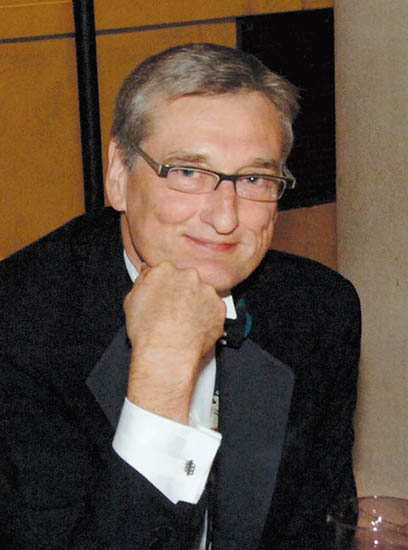
When Print Council of America members learned of Jay McKean Fisher’s death on March 7, 2024, at the age of 74, there was an unprecedented outpouring of emails expressing deep sadness, fond memories, and admiring tributes. Over the decades, Jay touched many lives across the country and abroad as an exemplary Baltimore Museum of Art (BMA) curator and colleague from 1975 to 2020 (thereafter, Emeritus Senior Curator of Prints, Drawings, and Photographs). Jay was constantly guided by his love of art, learning, and community. He had been a committed Print Council member since 1977, and he joined the editorial team of the Newsletter (now the Annual) in 1979, 1980, 1982, and 1985—working on early issues with its first editor/originator Betsy Fryberger. In those days, after members submitted hand-written or typed briefs, the coeditors oversaw the laborious process of retyping the entire issue (via typewriters!), photocopying, and collating by hand. As a Print Council board member (1980–94), Vice President (1985–89), and President (1989–93), Jay was masterful in leading the board and members meetings, and he excelled as a spokesperson championing the council’s goals and sharing its broad graphic arts interests.
At the memorial celebrating Jay’s life and career at the BMA on June 3, 2024, (his birthday) the auditorium was filled with many who had long respected and loved Jay: his cherished family (including a great-nephew named Jay); BMA colleagues, board members, and donors (among them, descendants of Claribel and Etta Cone, the sisters whose gift remains the core of the BMA collection); members of the vibrant Northeast cultural community; and longtime friends and colleagues, notably from Washington, DC, New York, Houston, and Paris. Following the memorial, the Nancy Dorman and Stanley Mazaroff Center for the Study of Prints, Drawings and Photographs displayed selected prints, drawings, and photographs acquired under Jay’s dedicated stewardship, including major donations honoring him, as well as those he gave in honor of others (including several PCA members). Memorial guests viewed featured works by Henri Matisse from the Marguerite Matisse Duthuit Collection and the Pierre and Tana Matisse Foundation in the Ruth R. Marder Center for Matisse Studies (which opened in 2020). The center is accessed via the Jay McKean Fisher Gallery—worthy public recognition of Jay’s instrumental role in acquiring hundreds of Matisse works for the BMA (making it a preeminent public collection of the artist’s work); in shaping the center; and in producing exceptional scholarship devoted to the artist’s oeuvre. Jay was the BMA’s Director of Matisse Studies beginning in 2016, and then he became the center’s Inaugural Director in 2019; he retired the following year.
Born in Portland, Oregon, Jay never forgot his West Coast roots. After graduating from Occidental College, Jay received his MA in 1975 from the Williams College–Clark Art Institute Graduate Program in the History of Art, where he maximized opportunities to study its graphic arts collection and served as an assistant. By fall 1975, Jay was an Assistant Curator at the BMA—specializing in nineteenth-century prints and drawings—working with curator Victor Carlson. Jay became Curator and Department Head in 1984, leading to roles as Senior Curator in the Department of Prints, Drawings and Photographs from 1997 to 2015 and Deputy Director for Curatorial Affairs from 1998 to 2015. During his years as Deputy Director, he capably oversaw the renovation and reinstallation of several major BMA wings and galleries, notably the Cone Wing. Additionally, during the BMA’s centennial in 2014, Jay helped oversee the museum’s special celebrations and the acquisition of more than 4,000 artworks.
Among the milestones in Jay’s career was the curatorial role he played in the out-of-court settlement of the 1995–97 lawsuit and subsequent purchase (with State of Maryland and private funds) granting ownership of the George A. Lucas Collection of Nineteenth-Century Art (numbering nearly 20,000 works, most being works on paper) to the BMA and the Walters Art Gallery (since 2000, the Walters Art Museum). The collection had been on long-term loan at the BMA for more than 60 years, yet its owner—the Maryland Institute College of Art—planned to sell it to raise money for the institution’s endowment. The challenging legal case and deaccession threat (also debated in the press) required gathering evidence based on updated Lucas Collection inventories and scrutiny of BMA exhibition, loan, and study access records going back decades—key efforts that Jay coordinated with Brenda Richardson and other BMA colleagues to a successful conclusion.
In addition to his BMA administrative duties (including being Interim Co-Director in 2015–16), Jay also organized numerous exhibitions (mostly based on the Lucas and Cone collections) and wrote scholarly catalogues (cited below in Rena’s tribute). Artforum named Jay’s exhibition Photographs, Drawings, and Collages by Frederick Sommer and Surrealist Art from the BMA’s Collection (1999) one of the ten best photograph exhibitions of the decade. From 1978 to 2000, he taught “A History of Prints, A History of Drawing” (using the Lucas Collection) at the Maryland Institute College of Art, in addition to teaching several print history and connoisseurship courses at Johns Hopkins University and Goucher College. In his free time, Jay enjoyed kayaking in the Chesapeake Bay, hiking, adventurous long-distance bicycling (notably his legendary solo cross-country trip to Portland, Oregon, in 1995), volunteering as a docent at Baltimore’s National Aquarium, and trips and visits with family and friends.
I met Jay in 1973, when he was a graduate student and I was a Smith College Museum of Art intern working with Elizabeth Mongan, Deputy Director and Curator of Prints and Drawings. We quickly bonded over wanting to pursue museum work specializing in works of art on paper. He was always a kind, loyal friend (for more than 50 years!); I was so fortunate to have had Jay there to consult as we progressed as peer curators at our respective institutions. We loved sharing friendships with many colleagues at Print Council meetings. I traveled to Baltimore to see most of Jay’s special exhibitions, learning so much from his expertise. Jay was there for a couple of my milestone birthdays, and I attended a few of his birthday celebrations. A complex, private person, who was outwardly warm and generous, Jay liked to tease with a quiet, wry humor. He was such a terrific “print buddy” and a willing listener on many subjects. Our memories of dear Jay—and all he achieved so remarkably—will live on.
Adapted from Rena M. Hoisington’s Eulogy at Jay’s Memorial at the BMA on June 3, 2024
It is humbling, truly humbling, to try to summarize a person’s accomplishments, especially when it comes to Jay’s contributions to the field of graphic arts. Jay hired me as Associate Curator and Department Head of Prints, Drawings and Photographs in 2006, and, in our twelve years of working together, my strongest memory is his passion for connecting people through art. What so many members experienced in the welcoming and more inclusive council that he fostered, especially during his time as President, was what he also did for Baltimore’s art community. We spent so much of our time with the members of the Print, Drawing & Photograph Society, among other local art enthusiasts.
Jay’s impactful contributions to the field of prints, drawings, photographs, and illustrated/artist’s books are defined by the many exhibitions he organized, including the international blockbuster Matisse and Modern Masters from the Cone Collection of the Baltimore Museum of Art, a traveling exhibition of works on paper presented in Japan (1996–97); the scholarship he published; his collaborations with fellow curators and conservators; and the multitude of acquisitions he championed during his BMA tenure. Important, too, was Jay’s thoughtful, sensitive, and accessible approach to discussing art; his talks were always well attended and enjoyed by audiences at the BMA or elsewhere. Ultimately, his life’s work was inextricably bound with his extraordinary command of, appreciation for, and dedication to the BMA’s collections and history.
Jay’s scholarship on French graphic arts—spanning from the eighteenth to the twentieth century—contributed vitally to the art history field far beyond Baltimore. Writing did not come easily to Jay (indeed, it doesn’t for many people); yet when he finally articulated his thoughts in written form, we are glad he did.
His exhibition catalogues are still widely read and remain essential to the study of the graphic arts today: Théodore Chassériau, Illustrations for Othello (1979, a catalogue raisonné incorporating unpublished research shared by several Paris-based experts); Félix Buhot, Peintre-Graveur: Prints, Drawings, and Paintings (coauthored with Colles Baxter, 1983); Regency to Empire: French Printmaking 1715–1814 (by Victor I. Carlson and John W. Ittmann, 1984; Jay was one of five contributing authors); The Prints of Edouard Manet (1985); The Essence of Line: French Drawings from Ingres to Degas (coauthored with David P. Becker et al., 2005); Matisse, Painter as Sculptor (coauthored with Dorothy Kosinski et al., 2007); Matisse as Printmaker: Works from the Pierre and Tana Matisse Foundation (coauthored with William S. Lieberman, 2009); Graphic Passion: Matisse and the Book Arts (by John Bidwell, 2015; Jay contributed an essay on Matisse’s maquette for Mallarmé’s Poésies); and A Modern Influence: Henri Matisse, Etta Cone, and Baltimore (ed. Katherine Rothkopf and Leslie Cozzi, 2021; Jay contributed supplemental textual content).
Additionally, Jay wrote periodical articles on Chassériau and Cone collection drawings, as well as essays for The Technique of Etching (Dover Books edition, 1981), Lasting Impressions: Lithography as Art (1988), and Alma Lavenson Photographs (1990).
The Prints of Edouard Manet (1985), to focus on but one of his landmark publications, remains an authoritative source on the artist (even with the impressive body of Manet scholarship published over the past four decades). In my opinion, this traveling exhibition catalogue still offers the most informative discussion of Manet’s printmaking process and its significance within his oeuvre. Jay’s writing about the details and nuanced differences between impressions, states, and editions helps one better understand how Manet’s revisiting of his paintings in graphic form offered the artist singular insight into his work. Indeed, Jay’s expansive thinking about Matisse’s work across media grew out of his sustained and close study of Manet’s graphics.
As a donor, Jay generously gifted the largest number of works from his personal collection to the BMA, in addition to at least half a dozen nineteenth-century French prints to the Clark Art Institute. With his gifts to museums, almost all were accompanied by extraordinarily thoughtful credit lines in honor or in memory of family, friends, and colleagues. These gifts speak, again, to the ripple effects of Jay’s meaningful relationships with many people and his singular ability to connect with people through art on multiple levels. I can think of no better way to celebrate Jay than to share, discuss, and spend time with works he loved and know that he will be there in spirit, complete with his Paul Smith socks, warm smile, and twinkling blue eyes.
Adapted from Kimberly Schenck’s Eulogy at Jay’s Memorial at the BMA on June 3, 2024, and Her Email to Print Council Members in March 2024
Mentors for conservators are frequently other conservators. My mentor was Jay. He would skip joyfully into the paper lab to show me what he had brought home from the Print Fair or found in the collection. He came not to ask me about treating the print, but to discuss the merits of the impression and how this particular print fit into the artist’s body of work.
Jay loved working with conservators and frequently visited our conservation studios at the BMA, whether it was to examine the progress of varnish removal on a painting, discuss the aesthetic impact of a frame for a particular work of art, view recent discoveries on a Matisse sculpture, or thoughtfully debate the qualities of a newly acquired print or drawing. Jay always valued our opinions and contributions, large or small. He showed an interest in the work of everyone in the department, whether conservator, technician, intern, framer, or volunteer. My former colleague in paper conservation Thomas Primeau recalls how Jay attentively read interns’ reports, discussed his expectations about their proposed treatments, and shared his knowledge about the artist. And when he asked the interns questions, he genuinely wanted to hear what they had to say.
Jay went out of his way to encourage conservation’s involvement in exhibitions and felt our expertise enriched people’s understanding and appreciation of art. In addition to preparing works of art for display and travel, we wrote essays for catalogues, created technical displays about artist materials, and presented gallery talks. We in paper conservation were frequently called upon by Jay to share our work and expertise with members of the Print & Drawing Society, the curatorial department’s friends group.
Jay was one of the most influential people, and at times the most significant person, in my career as a paper conservator. When I arrived at the BMA in 1988, I was fresh out of graduate school and knew very little. Jay and Jan Howard (who was then at the BMA) welcomed me immediately into the fold of the department. I couldn’t believe that they entrusted me to care for such wonderful and important works of art! Jay and Jan offered an amazing and enriching environment that I cherish still today. We spoke not only of the condition and conservation treatment of an artwork but also its artistic merits, its history, and how it was made. On more than one occasion, Jay would grab a solander box to show me something in the collection, then pull out another, and soon there were several boxes surrounding us, sometimes expanding onto the floor. Jay was the consummate mentor and teacher. When he taught me about the obscure etching technique of sulfur tint, he not only gathered prints incorporating the technique but ran to his office to grab a jar of yellow, powdered sulfur like Rembrandt used to create the subtle shading on his remarkable portrait of Jan Cornelisz. Sylvius. Then Jay said, “Here, take the jar.” I still have it, 30 years later, using it only once to create a copperplate for teaching. Most importantly Jay passed along to me his passion for looking at and learning from works of art. On my final day at the National Gallery of Art in 2024, when I retired as a paper conservator, I rummaged alone through boxes of drawings in the storeroom, and I smiled to myself. I knew Jay was there looking down from above, beside me, as we looked at art together, again.
What I learned from Jay was immense, and I forever will be grateful to him for his patience and willingness to share. May Jay’s legacy of the joy of art and the importance of the exchange between conservators and curators always be embraced by museums everywhere.
A Selection of Tributes by Former BMA Colleagues and Print Council Officers and Members
Jan Howard
While you may be most familiar with Jay’s scholarship on and collecting of modern French prints and drawings, I greatly benefited from his enthusiasm for photography at a time when many were still questioning whether museums should be collecting in this area. When I arrived at the BMA in 1985, several museum members were building extraordinary photography collections. The acquisition of the
Gallagher/Dalsheimer photography collection starting in 1988 was a game changer for the museum. Jay’s impact on our field and the BMA will be felt for decades to come.
Walter Melion
Jay was a kind, generous colleague to me during my early years at Johns Hopkins. The BMA print room, thanks to Jay, became my second home. With Yve-Alain Bois at Hopkins and Jay at the BMA, and thanks to the Cone sisters, Baltimore seemed like the center of the Matisse firmament in those days. And Jay’s many contributions to scholarship on Matisse will endure. He was incredibly modest about his administrative achievements. He was also a delightful traveling companion.
Mary Weaver Chapin, PCA President
I’d like to add another sterling attribute to Jay’s long list of endearing qualities: he was a generous donor. Long before he became a transformative curator, he was a kid in Oregon. He didn’t forget his roots; between 2001 and 2011, he made several gifts to the Portland Art Museum in honor of friends and family. His name, and those of the people he chose to honor, will live on at the museum.
Clifford (Cliff) S. Ackley
Aside from our shared professional interests in prints and drawings, Jay and I shared our origins as “Sons of the Great Northwest”: Jay from Oregon’s “Big City” of Portland, and myself from the state’s coastal village of Tillamook, “Land of Cheese, Trees, and Ocean Breeze.” I was endlessly impressed by Jay’s bicycle trek from Baltimore to Portland.
Richard Field, Past PCA President
Those of you who knew Jay remember the kindest of gentlemen, a PCA member and President who welcomed everyone with support, interest, and scholarly concern. To this day how grateful I am for his sympathy and counsel during my first year as President (succeeding Jay, as a matter of fact). Without warning, I was compelled to negotiate the problems raised by PCA’s forthcoming 1995 meeting in Cincinnati. The citizens of Cincinnati had recently voted to excise language from the city’s civil rights statutes that had supported the gay community. It was to Jay I turned for advice and moral support. I felt that we should not cut and run, but hold our meeting in Cincinnati and make certain that our very mixed membership represented a gesture of condemnation of such an uninformed and closed-minded decision. . . . Jay was a wonderfully caring and generous friend and colleague. I will miss him. We will all miss such a fine person.
Martha Tedeschi, Past PCA President
To the many messages from PCA colleagues that have perfectly echoed my thoughts about Jay, I add my own gratitude for his collegiality and humanity, not to mention his deep knowledge of and passion for his fields of interest. I will note one small recollection from PCA meetings, which is how lucky I felt when I happened into a seat on the bus with Jay. He was always so supportive, and I always knew there would be a wonderful answer when I asked, “What are you working on?”
Judy Weiss Levy, Past PCA Secretary
My first memory of meeting Jay was in Williamstown. I drove into town and was moving into Maxey House on Hoxey Street to begin my graduate school studies. As I was walking in, Jay was leaving, bags in hand, heading to the BMA for a job as a print curator. I thought, wow—there’s hope for me and I’m in the right place. From that day on, Jay continued to be someone who was always there for advice, guidance, and friendship.
Cheryl K. Snay
Jay was a wonderful person with a gentle soul. From 1999 to 2004, I worked with him, Bill Johnston, and Kimberly Schenck on my first big project out of grad school: The Essence of Line (2005), on nineteenth-century French drawings. I think of him every time I run across a Buhot print. What I remember most is when someone at the BMA brought in two stray kittens they had found on the side of the road and Jay adopted them. He kept them in his office that day, and there was a parade of staff visiting the two orphans. If I remember correctly, he named them Sadie and May after an early museum benefactor. So very Jay. He is sorely missed.
Hilliard Goldfarb
Others have spoken of Jay’s significant contributions to the profession and the PCA and of his guidance and enrichment of the distinctive and distinguished collection at the BMA. Yet I also retain so, so many personal memories over the years. I need only say to myself, “Speak, memory,” and I hear his voice and gentle laugh. In the words of Laurence-Marie Coupier: La mémoire est un livre qui ne se ferme jamais.
Jim Ganz, Past PCA President
When I was just starting out in this field, Jay was one of my idols. When I first met him, I was so thrilled to find him to be so welcoming, encouraging, and down-to-earth. If this is what one of the top curators in the field was like, then I knew that I was on the right path. I’ll always cherish my memories of Jay as a mentor and friend.
Here are some of Jay’s own words, from the council’s 50th anniversary booklet (2007): “Suffice it to say that the positivism and encouragement that Print Council brought to my professional life defined my own values and established a sense of well-being and pride, but most of all friendship, that defines my relations to colleagues, and to my fields of study.”
Notes:
See also Ruth Fine’s obituary in Print Quarterly 41, no. 2 (2024): 214–15.
Marilyn F. Symmes is grateful to Joanna Karlgaard, who kindly checked information in the BMA Archives.
Contributions are welcome to the Print Council’s Annual Meeting Travel Grants Fund in memory of Jay McKean Fisher, which provides aid so that newly elected members can attend the Annual Meeting. Please donate via our website, via PayPal, or by contacting Treasurer Christine Giviskos (printcounciltreasurer@gmail.com) to confirm ways to donate, including by check. Past President Shelley Langdale suggested this memorial fund as a fitting legacy for Jay, who always welcomed younger colleagues into our field; her proposal was immediately endorsed by the board and membership in March 2024.