In Memoriam
Sue Welsh Reed (1936–2025)
by Suzanne Boorsch, Robert L. Solley Curator of Prints and Drawings, Yale University Art Gallery, retired
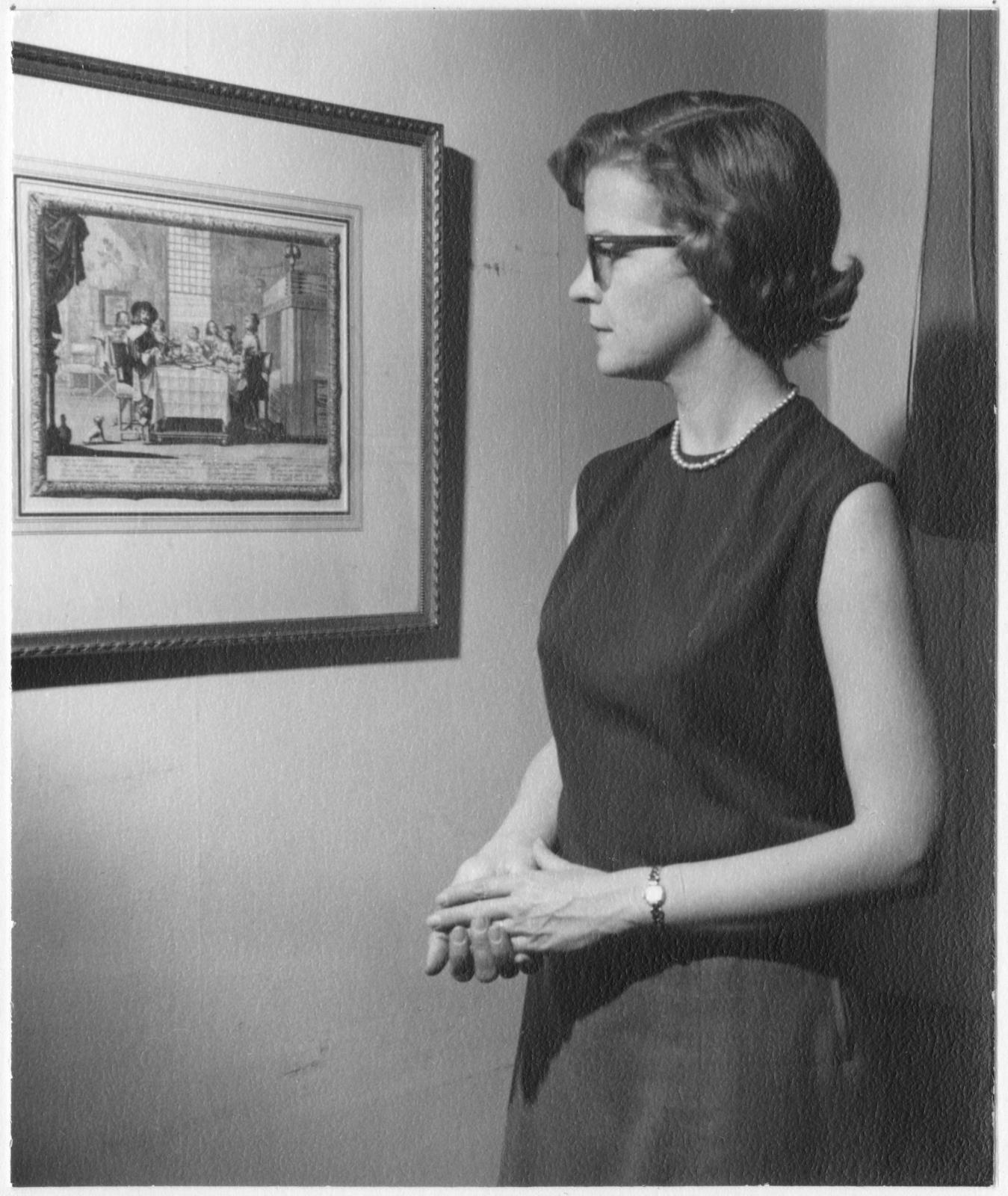
This memorial of our dear colleague Sue Welsh Reed is fairly short, even though I am almost certainly the person in the Print Council of America who knew Sue the longest, since we were college classmates. But ironically, even though we were both art majors, we didn’t know each other well then (I hesitated between majoring in art or English). I spent junior year in Paris, while Sue stayed in the US and got engaged to the wonderful John Stewart Reed, recently graduated from Harvard—they were married a few years later, on Valentine’s Day!
Fortunately for me, we made up for this lack of closeness in the decades that followed. Whenever I needed a bed in the Boston area, Sue and John, with unfailing generosity, invited me to stay in their charming Queen Anne–style house at the top of a hill in Cambridge, so I saw a lot of them, and I got to know their twins, Beatrice and Elizabeth, at an early age and had the pleasure of following their growing up—and later, even getting to know Elizabeth’s sons, James and Nick, a bit. Our first real professional collaboration happened in 1976, when the Jacques Bellange exhibition that Sue and Amy Namowitz Worthen co-curated went to the Metropolitan Museum of Art, where I had begun working in the print department a few years earlier. I was lucky enough to be charged with coordinating and installing that eye-opening, quite daring exhibition—Mannerism was still unfamiliar to much of the viewing public, and many found Bellange’s work bizarre.
Over the years, Sue and John hosted me dozens of times—as indeed they did countless other out-of-town or foreign friends and colleagues. Their generosity extended to taking in high schooler Alex Abramowicz, son of their friend, artist Janet Abramowicz, for much of a school year, while she was in Japan on a Fulbright. The last time I saw Sue, at the Museum of Fine Arts, Boston's (MFA Boston) memorial event for Barbara Shapiro in 2020, her memory loss was already quite advanced, but after she invited me several times to stay the night, I knew that the basic Sue was still there. (John was at that event too; at that time, he was doing an extraordinary job of taking care of Sue. He died, suddenly, in December 2023.)
Amy has written about working with Sue on the Bellange exhibition, and Stephanie Stepanek about Sue’s career at the MFA Boston, so I’ll make just a few remarks on the more personal side. To me, Sue was a quintessential New Englander—modest, practical, hard-working, dependable, down-to-earth—and indeed her life was spent in New England, growing up in Cambridge as the daughter of a Harvard professor of zoology, attending Smith College in Northampton, earning an MA from Harvard, and spending summers in Boothbay, Maine, to say nothing of her career at Boston’s foremost museum. This is not to say that she didn’t enjoy traveling, to France, Italy, and elsewhere (if with John, so much the better!). Several times I joined her for lunch at the small café on the square right outside the Bibliothèque Nationale in Paris, with the print curators there, with whom she had become good friends.
Sue wasn’t overly conventional, although she admitted to being embarrassed when the twins, around age three or four, were being tested and when shown an image of an iron, they had no idea what it was! As attested by many of our colleagues, Sue was kind through and through. She was genuinely and patiently interested in other people’s concerns, both professional and personal; she helped me greatly through discussions about engraving, as a general practice and concerning its particular history in fifteenth-century Italy.
Sue was admired by all who knew her and widely loved. She is and will continue to be hugely missed.
Sue Welsh Reed, the Definition of a Curator: A Personal Reflection
by Stephanie Loeb Stepanek, Curator Emerita of Prints and Drawings, Museum of Fine Arts, Boston1
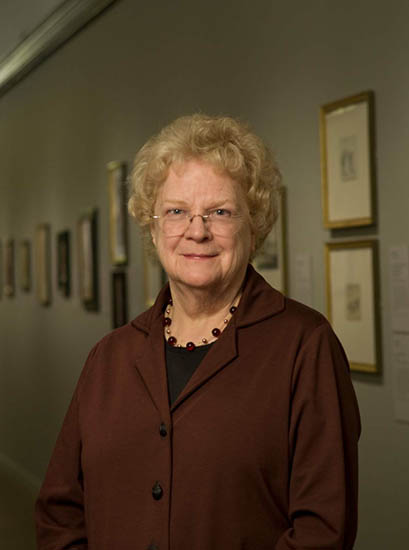
Sue Welsh Reed, Curator Emerita of Prints and Drawings at the Museum of Fine Arts, Boston (MFA Boston), and President of the Print Council of America from 1981 to 1985, died peacefully in Boothbay, Maine, on November 19, 2025. From the beginning of her career in 1959 until her retirement in 2005, and beyond, Sue was a stalwart and vital mainstay of the Department of Prints, Drawings, and Photographs at the MFA Boston, contributing her energy and intelligence, her informed eye, and her patiently cheerful spirit to virtually every aspect of the department’s activities.
I worked with Sue my entire career, from my vividly recalled first day at the MFA Boston in 1965 until years beyond her retirement. I learned from all the staff in the department, but Sue and I were closer in the hierarchy (for a time), and it seemed natural to follow her practices while absorbing her knowledge and experience. We were also smoking buddies (for a time), the occasions when much valuable information was shared. Our professional interactions, whether day-to-day exchanges about museum business or longer discussions when viewing works of art, were consistently rewarding, often combining her special interest in print techniques with fresh insights. As sometimes happens with colleagues, our personal lives were woven into our work environment, contributing to a warm atmosphere that nurtured our longtime friendship.
Born and raised in Cambridge, Massachusetts, and summering in Boothbay, Maine, Sue seemed to embody certain qualities of a typical New Englander, an observation often made by Clifford Ackley (born and raised in Oregon, who lived almost his entire life in Boston). While it is difficult for this author (raised in Brookline, Massachusetts) to define a New England character, generalizing and informed by literature, the types tend to be reserved, modest, plainspoken, of independent mind, occasionally sardonic, inflected with irony when making observations, careful with expenditures, something like Jo March or Olive Kitteridge. All of this is true of Sue to an extent, but she was so much more. She was neither prim, starchy, nor overbearing. While she could exude confidence and authority in areas she commanded, Sue was unfailingly generous in sharing her knowledge and always open to learning from others.
Evidence of Sue’s career direction emerged at a young age. In her 2008 PCA oral history with Aprile Gallant at Smith College, her alma mater, she noted that her observational skills may have developed early when she took to drawing bugs and insects during visits to natural history museums with her parents, both biologists. Her later curatorial research included sketches of what she studied, both as memory aids and a means to understand an artist’s creative process.
At Smith, Sue initially planned to major in studio art. She was surely inspired by the faculty member, sculptor, and printmaker Leonard Baskin, who may have introduced her to printmaking, thus stimulating her lifelong interest in the expressive visual effects of specific techniques. Her Art History 101 class with David Huntington, whom she remembered fondly for his humor, motivated her to switch to a major in art history. In her class at Smith, she met Suzanne Boorsch and, later, another Smith graduate, Amy Namowitz Worthen, who also became a lifelong friend and collaborator—both of whose warm “memories” are also included here. Through the years, Sue maintained ties to Smith as a donor, as a member of the Smith College Museum of Art’s Visiting Committee, and as its Chair from 1990 to 1995.
For her honors thesis, her advisor, the professor of Baroque art Robert O. Parks, recommended the inventive work of Jacques Bellange, a Mannerist etcher from Lorraine, known then primarily to connoisseurs. Sue’s research involved studying the Bellange collection at the MFA Boston, among the foremost anywhere, including, of its seventy-six prints, some 60 purchased in 1940 and once owned by Robert-Dumesnil, the artist’s primary cataloguer. The originality and serious scholarship of this thesis were impressive, a signal of her future. The pleasure she experienced studying the Bellange prints there likely stoked her determination to pursue museum work in the field of prints. In 1958, Sue graduated from Smith College, magna cum laude with honors in art history and elected to Phi Beta Kappa.
During her Smith years, Sue met John Stewart Reed, whose family summered in Boothbay Harbor near the Welshes. He courted her in his Model T, surely a romantic gesture even at that time, and they were married in 1959.2 John was an economist and consultant to foreign governments. His frequent, somewhat mysterious, travels took him far from home, but he was equally happy to be on the water, sailing off the shores of Maine.3
After graduation, Sue secured a position at the Institute of Contemporary Art in Boston, located within the School of the Museum of Fine Arts in the Fenway across Museum Road from the MFA Boston. There she worked as a secretary in the design department, focusing on Tunisian crafts. But her ambition was to work in the MFA Boston’s Print Room, and within the year, in 1959, after having taken a typing test, she was hired as secretary, a title no longer used for the entry-level position. Fast and accurate typing was a skill that Sue valued throughout her curatorial career.
One could not ask for a better introduction to the world of prints and drawings than Boston’s vast, superb collection of Western works on paper. Sue’s responsibilities ran the gamut: she typed acquisition and loan paperwork, letters, and articles for curator Henry Rossiter; she answered requests for information by telephone and post; she met visiting artists, dealers, scholars, and collectors; and she enjoyed the “best job”—the retrieval of prints, drawings, watercolors, and rare books for classes and visitors. Until the 1970s, the Print Room had an open-door policy—no appointments needed. She also assisted in the rotating exhibitions of works on paper in the various galleries. Through all these roles—from the menial task to the more visible installation—Sue gained an impressive knowledge of the collection and the various duties involved in curatorial work. None of this was dull.
In those first years at the MFA Boston, Sue was also involved in the final cataloguing and proofreading for the two-volume catalogue M. & M. Karolik Collection of American Water Colors & Drawings (1962). This collection of more than 5,000 works (almost 1,500 were published in the catalogue) laid the foundation for her extensive knowledge of American watercolors and drawings—a field that paralleled her expertise in Bellange and French prints from the sixteenth through the nineteenth century.
Rossiter’s support for Sue was evident in his recommendation of her Smith thesis on Bellange for inclusion in the PCA’s 1962 publication Prints, edited by Carl Zigrosser. One of the first publications of the PCA, it contained thirteen articles that are consulted to this day. One of the other authors was Peter A. Wick, assistant print curator at the MFA Boston, who wrote on Paul Signac and who Sue looked up to as a mentor in her early working years. For her article based on her undergraduate thesis to be published along with more established curators was a remarkable accomplishment for someone so new to the profession. The Prints article made evident the originality of her subject, her serious scholarship, her clarity of observation, and her ability to describe what she saw with a lucidity that characterized her writing throughout her career. Ten years later, Sue was considered to be the leading American scholar on Bellange, prompting Amy Namowitz Worthen, a young curator at the Des Moines Art Center, to reach out about collaborating on an exhibition.
Feeling the need to advance her career, and encouraged by Rossiter, Sue was admitted to Harvard for a year of graduate work. She thrived at the Fogg, focusing on works on paper: Rembrandt, as well as Early and High Renaissance painting, and special studies with Agnes Mongan on drawings by Benozzo Gozzoli.4 It was at this time that Sue’s interest in Italian Renaissance and Baroque works on paper developed. She earned a master’s degree in 1965.
On her return to the MFA Boston, I was hired into her former position, and Sue assumed greater responsibilities in the Department of Prints and Drawings.5 While staffing was constant and financial resources were limited, the museum was not lavish in doling out promotions and titles. But the work was fulfilling and rewarding, and Sue was able to balance childrearing of twins, Elizabeth (Betsy) and Beatrice (Bea), and professional requirements. Over the years, in acknowledgment of her many achievements, she was promoted from curatorial assistant to assistant curator (1978) to associate curator (1985) to curator (1999).
For 20 years, beginning in the mid-1960s, the programming in the department was essentially directed by Eleanor A. Sayre, who was promoted to curator after Rossiter retired in 1967.6 Sayre, who became a prominent Goya scholar, was an exceptional mentor who encouraged her staff to take on greater responsibilities and independent projects while also promoting collaboration. The department flourished, producing several ground-breaking and influential exhibitions with catalogues that brought significant parts of the collection to full light: Rembrandt: Experimental Etcher (1969) (also with Felice Stampfle at the Morgan Library; Sue worked on Rembrandt watermarks); Albrecht Dürer: Master Printmaker (1971) (Sue focused on the engravings); and The Changing Image: Prints by Francisco Goya (1974) (Sue drafted entries on The Disasters of War). To a greater or lesser degree, junior staff (Ackley, Reed, Shapiro, and myself) drafted entries under Sayre’s tutelage or guidance, and she corrected, edited, and refined them. These exhibitions and publications, initially inspired by the MFA Boston’s founding print curator Sylvester R. Koehler (1837–1900), focused on technique, states, and the revelation of the artist’s idea or imagination through the stages of the creative process. Such collaborative publications done in consultation with paper conservators Francis Dolloff and Roy Perkinson, as well as outside scholars, are a hallmark of the museum during this period and remain important research tools for students of works on paper. Sue was vitally important to these projects, significantly enriching them.
In the late 1960s, Sue made a discovery in the collection: the source of the adolescent Winslow Homer drawing Rocket Ship (13.4499) in a Nathaniel Currier 1849 “gold rush” lithograph, The Way They Go to California, which was, in turn, based on an English lithograph. Perhaps it was not a priority for MFA Boston publications at that time, so Sue, the resourceful New Englander, sent the article to Yankee magazine, where it was published in February 1970.
Significantly, in the early 1970s, Amy Namowitz Worthen was exploring the idea of putting together a Bellange exhibition. She had read Sue’s article in Prints and knew that both Sue and the MFA Boston’s collection of Bellange works would be essential to any project she might develop. Amy and Sue thus became research partners in their study of Bellange, as well as lifelong friends. They curated the landmark exhibition The Etchings of Jacques Bellange that opened in Des Moines in October 1975. Amy’s superb, vivid remembrance of Sue beautifully captures their bond.
That same year, Sue and Cliff organized at the MFA Boston the first American Print Conference: Art & Commerce: American Prints of the Nineteenth Century. Later, her assistance with his 1981 exhibition Printmaking in the Age of Rembrandt was indispensable.
Bellange and French printmaking in general were to become major areas of focus for Sue’s scholarship and curatorial expertise throughout her life. But her knowledge of and enthusiasm for other artistic traditions went well beyond that. She curated in-house shows and managed diverse loan exhibitions: French prints (including monotypes) from the Renaissance to the nineteenth century, early Italian etchers and engravers (Bernini drawings from Leipzig), and American works on paper (Shaker spirit drawings, Joseph Stella drawings, and Edward Hopper prints) represent only a handful. These smaller-scale installations supplemented her primary scholarship, which included an array of major exhibitions accompanied by original and enlightening catalogues.
Initially under Sayre, and subsequently in 1984 when Cliff assumed the curatorship of the department, Sue curated a series of significant scholarly exhibitions with catalogues. As curator, Cliff was admired for the breadth of his knowledge of art across time, place, and media, for an astute eye, for a range of shrewd and forward-looking purchases, and for a series of creative exhibitions and their catalogues. The staff learned from his example, and he encouraged and supported their and Sue’s exhibitions. Many of Sue’s projects took the form of collaborations with colleagues both within and outside the MFA Boston, as well as contributions to outside exhibitions: The Painterly Print: Monotypes from the 17th to the 20th Century (1980) (with Colta Ives at the Metropolitan Museum of Art); Edgar Degas: The Painter as Printmaker (1984) (with Barbara Stern Shapiro); Italian Etchers of the Renaissance & Baroque (1989) (with Wellesley College scholar Richard Wallace); Awash in Color: Homer, Sargent, and the Great American Watercolor (1993) (with Carol Troyen); The French Renaissance in Prints from the Bibliothèque Nationale de France (1994); Richelieu: The Cardinal, Power and Art (2002); and Impressions of Light: The French Landscape from Corot to Manet (2002). Of particular note was her fruitful collaboration on the 1989 Italian Etchers exhibition, supported by a three-month study trip to Florence and extended travel. The beautifully designed catalogue was printed on Fabriano paper, which Sue secured through a family friend. Her scholarship in the above is well captured in the words of the Boston collector of Italian prints Stephen Bergquist: her catalogues “are like Bibles to me—sources to return to time after time.”
One of her greatest accomplishments, French Prints from the Age of the Musketeers (1998), was conceived by Sue alone, with contributions from local and international scholars, including Alvin L. Clark Jr. and H. Diane Russell. Its primary aim was to highlight French Mannerist printmakers as a complement to the earlier Italian print show. It was the first large exhibition to explore prolific and well-known printmakers of the seventeenth century, such as Abraham Bosse, Claude Lorrain, and Jacques Callot, alongside and in context with lesser-known artists. This exhibition, which traveled to the National Gallery of Canada, Ottawa, and the Mona Bismarck Center, Paris, proved noteworthy in many ways. For the MFA Boston’s print department, the most unforgettable was a celebratory costume party (plumed hats aplenty) hosted with flair by Sue and John at the Higgins Armory in Worcester.
Beyond her original and fascinating exhibitions and her publications, throughout her term at the MFA Boston, Sue was central to many projects relating to access and management of the collection. She was an excellent coordinator of the multiyear major renovation and consolidation of the department’s storage.
One of the most significant and far-reaching ventures involved the development of the Paper Sample Book. In preparation for the Degas exhibition of 1984, Sue and Barbara Shapiro consulted Roy Perkinson, Liz Lunning, and Mellon Fellow Joan Wright in the Paper Conservation Laboratory. All had long been frustrated by the lack of consistency in the description of papers made by curators during research travels (varying lighting situations, varying eyes). Drawing from the deep reserve of handmade and manufactured papers collected over the years, Roy and his team compiled a loosely gathered book of samples arranged by color, texture, and weight, providing a standardized vocabulary for the description of papers in prints and drawings. The prototype proved its worth on a research trip taken by Sue and Joan in preparation for the 1989 Italian Etchers exhibition. With many hands, including Annette Manick, Alison Luxner, Katrina Newbury, and Gail English, this prototype was eventually turned into an edition issued by the PCA in 1996. Roy noted that the project may not have succeeded without Sue’s enthusiasm and support.
Current and retired MFA Boston staff, as well as numerous interns, have brought forth a range of meaningful instances of Sue’s influence on their own experiences. Anne Havinga, who began her museum career with an interest in Dutch prints and went on to become Curator of Photographs, was introduced to the works of Alfred Stieglitz (the first photographs added to the collection in 1924) by Sue, who managed them at the time. Tom Rassieur noted her knack for making magic of smaller projects, such as the exhibition American West: Dust and Dreams (2005). I embarked on new territory when Sue enlisted me to write the artist biographies in French Prints from the Age of the Musketeers. Sue’s ubiquitous presence—her persistent exploration of the collection—has been observed by Katherine Harper, who noted Sue’s signature, more than any other, on the sign-out sheets in the print and drawing solander boxes. For Patrick Murphy, Sue was the most approachable curator, unstinting in her willingness to share her knowledge. Benjamin Weiss credits Sue for supporting his career and describes her first confronting, then studying, then contemplating a work of art: eyes wide, then closed in contemplation, then speaking. This compelling image evokes one of Sue’s own explanations for her love of prints, the joy she felt, the “ah-ha” moment in discovering an artist’s secret.
Gallery talks were an essential part of the curatorial role, and on occasion, we were given the opportunity to teach classes in the Study Room using the collection. As we all did, Sue enjoyed these experiences—similar to the process of writing, calling forth new ideas we did not know were there when we began. For a time, the MFA Boston supported a program of seminars linked to local colleges and universities. In 1983 and 1985, Sue and Barbara Shapiro taught French printmaking from the sixteenth to the twentieth century. One of Sue’s students from Boston University is now Curator of Photographs at the MFA Boston, Karen Haas. In the section on French Tenebrism, Karen drew inspiration from Sue, awed by her depth of knowledge and her ability to express what she saw in her engagement with the original.
Especially stimulating for us as instructors was what came to be referred to as “The Class,” a yearlong seminar on the history of prints, which Sue coordinated. The students were volunteer gallery instructors, often retired from other careers, who wanted to learn more about prints and drawings so as to lecture in the galleries. Their attendance was near perfect; they were alert and inspired by what they saw. They submitted intelligent, well-researched papers with original observations that informed the teachers as well as the students.
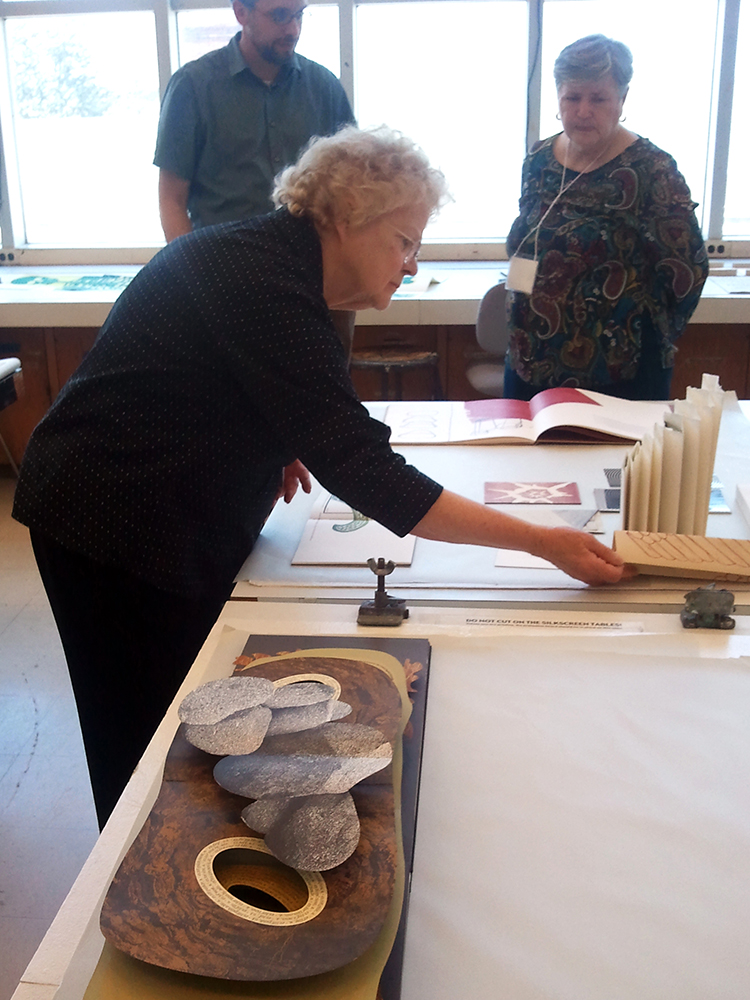
At the height of her career, Sue’s activity also extended beyond the museum in two diverse directions: her role in the PCA and as a warm and gracious hostess. In 1972, Sue became a member of the PCA, and in 1981, after having served as Vice President under Andrew Robison, she was elected President, serving two terms, until 1985. In her oral history, she recalled that her term was a quiet time. Quiet perhaps, but quite productive, and marked by serious reflection on the value of the organization. During that period, she and Andrew saw the 1983 publication of Timothy Riggs’s The Print Council Index to Oeuvre-Catalogues of Prints by European and American Artists, which has become an online staple for our profession and for dealers and collectors as well. In 1983, Sue and her board, through questionnaires sent to the members, sought information on the burgeoning use of computer databases to catalogue their collection. As Marilyn Symmes reflected, “What babes we were then. . . .” In her oral history, Sue mentioned that the paperwork for the President was so voluminous that she would have needed a secretary, but she valued the organization highly for providing younger curators the opportunity to learn from the experienced members and to hear about nascent projects and exhibitions at other institutions. She singled out the strong presence and collegiality of Chicago’s Harold Joachim, of whom the younger members were in awe. In my own experience, I treasure the memory from 1977 of a bus ride near Jenkintown where I sat next to Elizabeth Roth of the New York Public Library, who was at once welcoming and impressive. Since then, I have made an effort to sit next to an unfamiliar young person on those often adventurous bus journeys.
The costume party celebrating the Musketeers exhibition at Worcester’s Higgins Armory (the armor collection is now at the Worcester Art Museum) was the most stylish, but only one of the many examples of hospitality and social outreach offered by the Reeds. At their Queen Anne–style home on Bellevue Avenue in Cambridge, Sue and John hosted Thanksgiving for staff members without nearby families, department celebrations of milestones, and thank-you parties for departing interns, as well as offered overnight accommodations for visiting curators. Such occasions ranged from backyard barbecues to more formal dinners. As an example, on the occasion of my 2014 exhibition Goya: Order and Disorder, Sue and John held a dinner party hosting Manuela B. Mena Marqués from the Prado (who as a graduate student had interned at the MFA Boston in the 1970s), her husband Sir Norman Rosenthal, collectors Lia and William Poorvu, Ben Weiss and Carla Chrisfield, Clifford Ackley, and my husband Josef Stepanek. And as a footnote, Sue’s domestic side was never too far from the surface, as evidenced by her sharing of a recipe called “Aggression cookies” with our PCA President Debora Wood, who sought a way to occupy some restless children.
In her later years at the MFA Boston, in about 2002, Sue embarked on another exhibition project on French Mannerist works (prints, drawings, paintings, and sculpture) conceived to complement the 1989 Musketeer exhibition. Her co-curator was Alvin L. Clark Jr., curator for the North Shore collector Jeffrey Horvitz, who had contributed to the earlier exhibition. The exhibition was to be titled Caron to Callot. They traveled extensively, as far as Russia, in their research and pursuit of loans. In fact, loan letters had been written when the show was dropped from the schedule, likely during the economic downturn of 2008, or when the museum’s priorities shifted at the time of the planning for the Art of the Americas Wing, which opened in 2010. Sue expressed hope that the MFA Boston or another museum would be able to mount the exhibition. It would have been (and still would be) a beautiful and pioneering exhibition revealing little-known French Mannerist works, curated by two experienced and eminent connoisseurs and scholars.
After retirement in 2005, she continued to research, advise on, and contribute to special projects. A highlight was the popular and wide-ranging exhibition American West: Dust and Dreams, which included prints, drawings, watercolors, and photographs by American and Indigenous artists from the nineteenth and twentieth centuries drawn from the collection.
In 2006, Sue received public recognition for her achievement as a curator. The French Consulate in Boston, on behalf of the French government, awarded her the distinguished title Chevalier de l’Ordre des Arts et des Lettres in recognition of her contributions to the history of French graphic arts; she had been nominated by MFA Boston benefactor Lia Poorvu. The ceremony, attended by her family and numerous admirers, including visitors from France, took place on October 30, 2006, in the Morse Study Room at the MFA Boston. It was a superb celebration, a fitting tribute to an outstanding curator. In the following years, Sue contributed an essay to the catalogue for the exhibition Goya: Order and Disorder, which I co-curated with Frederick Ilchman in 2014. A career coming full circle.
This is Sue’s story, but I would be remiss not to draw attention to the many PCA members and other distinguished museum professionals who worked in various positions the Department of Prints, Drawings, and Photographs and the Paper Laboratory and who were influenced by the talented staff and the synergy of their practices. They were fortunate to have experienced Sue’s indelible spell.7
Beautiful Angel: Remembering Sue Welsh Reed, The Etchings of Jacques Bellange, and Our 50-Year Friendship in Prints and Life
by Amy Namowitz Worthen, Curator of Prints and Drawings, Emerita, Des Moines Art Center
One day in 1972, a new book arrived at the Des Moines Art Center’s (DMAC) library. It was Nicole Walch’s Die Radierungen Des Jacques Bellange (1971), a catalogue raisonné of Bellange’s etchings. Director Jim Demetrion knew that I was interested in Northern Mannerist prints and asked me, “Why don’t you organize an exhibition of Bellange’s prints?” Knowing how rare impressions of Bellange’s etchings are (the DMAC did not own any), I answered, “You are crazy!” At this point in my life, I had only read Sue Welsh Reed’s 1962 article on the idiosyncratic seventeenth-century Mannerist court artist of Lorraine, paged through Walch’s book, and noticed a few of his prints were for sale in the catalogues of old master print dealers.
A few days later, Jim asked me the same question again. I told him that there was no way on earth that we could mount an exhibition of Bellange’s etchings without joining forces with the Museum of Fine Arts, Boston (MFA Boston). It had the largest and most important collection of Bellange’s prints anywhere (rivaled only by the Bibliothèque Nationale in Paris), and not to mention, the leading American scholar on the artist worked there. Nevertheless, he urged me to explore possibilities. No survey exhibition of Bellange’s prints had ever been done.
During the early 1970s, we were at the dawn of a new, golden age of major scholarly print exhibitions. I had been blown away by shows such as Rembrandt: Experimental Etcher (1969) and Albrecht Dürer: Master Printmaker (1972) organized by the MFA Boston’s team of scholar-curators in the Department of Prints, Drawings, and Photographs, and I had hungrily read those catalogues. I fully expected that Boston would find our small Midwestern art museum’s proposal absurd, but I made an appointment to meet with Curator Eleanor A. Sayre and Sue. They warmly welcomed me to the department. There, I looked at the sixty-six Bellange etchings (!) then in their collection and talked with Sue. I learned that at Smith College, she had written her honors thesis in art history on Bellange and that it had been the basis for her published article. By happy coincidence, I graduated from Smith College nine years after she did. We had studied with some of the same professors, including artist, collector, and scholar Leonard Baskin, from whom both of us had learned much about printmaking and old master prints.
Unexpectedly, rather than rejecting the proposed collaboration with a relatively unknown Des Moines team, Sue was very much in favor of it. She saw our proposal as an opportunity. She had come to realize that the MFA Boston was unlikely to dedicate the resources necessary to organize a traveling print exhibition on Bellange, an artist known mostly to specialists interested in the then very much out-of-favor style of Late Mannerism. Sue embraced the idea and convinced Sayre to agree to the project. Our two museums worked out a collaboration. Sue and I would jointly curate the exhibition and write the catalogue. The DMAC would organize the loans and logistics. The MFA Boston would design and produce the catalogue. The Metropolitan Museum of Art signed on as the third venue for the exhibition, with Suzanne Boorsch as the young, new curator assigned to coordinate it there.
Over the next several years, as we collaborated on the project, we became good friends. Sue and I traveled together to Paris and Nancy to research Bellange. We met with the catalogue raisonné author Nicole Walch. In Paris, I acquired a Bellange etching for the DMAC’s permanent collection. The Bellange exhibition we were planning, the first-ever survey of his prints, would come to include sixty-eight prints (the finest available impressions) and drawings loaned by major institutions. In the catalogue, we would present new, original research, close looking at the impressions, and deep thinking about the artist as an etcher.
Sue was the best writer about prints of anyone I have ever known. Her personal, hands-on experience of making prints infused and illuminated her writing. Deeply interested in etching’s graphic language, she looked closely at prints and noticed things. She taught others to look and to discover what she saw. Sue had a revelatory way of describing the distinctive, autographic marks each etcher made with needle, acid, burnisher, and scraper. She gave the reader the sense of making an etching, figuratively placing the tools in the reader’s hand. (See, for example, her comparison of Bellange’s The Virgin with the Spindle and Barocci’s Annunciation, numbers 8 and 9 in our catalogue). I learned so much from Sue and recommend that everyone writing about prints should study and emulate her work. As the catalogue numbers of Bellange prints, Worthen-Reed became joined forever.
In October 1975, The Etchings of Jacques Bellange opened in Des Moines. In December, it opened at its second venue, the MFA Boston. There, designer Carl Zahn’s lavender-themed gallery walls (which undoubtedly alluded to the gender fluidity of Bellange’s figures) and the fully illustrated catalogue were stunning. We loved John Canaday’s enthusiastic and complimentary but hilarious review of the exhibition in The New York Times.
The cover of the catalogue for “The Etchings of Jacques Bellenge,” a new exhibition at the Metropolitan Museum, is a color that could be christened Boudoir Mauve—a cross between shocking pink and a mixture of grape sherbet and strawberry soufflé blended with plenty of whipped cream. Some flecks of paint of the same color on the edges of a frame on two indicate that at either the Des Moines Art Center, where the exhibition originated, or at Boston’s Museum of Fine Arts, where it was shown before concluding its tour at the Metropolitan, the etchings were exhibited on Walls of the same tint—which could have served as fair warning to visitors unacquainted with the art of Bellange that they were about to enter into an esthetic experience of rather strange flavor.
As we all know, Sue went on to organize many other distinguished exhibitions. I note her splendid Italian Etchers of the Renaissance & Baroque (1989). In 1987, Sue, my daughter Maria, and I briefly lived together in Florence when she was conducting her research on that exhibition and I was house hunting. Her exhibition and catalogue French Prints from the Age of the Musketeers (1998) was a capstone achievement, a testament to her scholarship and love of seventeenth-century French art.
Sue became a role model for me. When we first met, she was then a young mother of 8-year-old twin girls and maintained a productive career as a print curator and scholar. She became my big sister in the print world. Many of her colleagues in the department, especially Clifford Ackley, Stephanie Stepanek, Barbara Shapiro, Shelley Langdale, and Roy Perkinson, as well as Eleanor Garvey, Marjorie Cohn, David Becker, and, of course, Suzanne Boorsch, became lifelong print siblings and dear print friends to me too. In 1974, Sue and Gustave Von Groschwitz had proposed me as a member of the Print Council of America, bringing me into a special collegial world. She would later serve as the PCA’s President.
48 Bellevue Terrace became an important reference point for me and my family. In 1975, when we moved from Iowa to Cambridge for my husband Tom to study at the Fogg, Sue and John generously welcomed us to live in their house with our one-month-old daughter Shana (while they were summering in Maine), until we found an apartment to rent a few blocks away. In Cambridge, I was happy to be back on the East Coast, but while Tom was deeply engaged at the Fogg, I felt isolated with our new baby. The Reeds, now near neighbors, kept me going. Sue’s calm personality was an anchor. In 1978, morning sickness I suffered while eating (or not being able to eat) breakfast at Sue’s house clued me in that I was pregnant again. Over the years, the Reeds would host various Worthen family members on our trips to Boston.
As decades flew by, Sue continued to connect me with opportunities and people. I followed in her footsteps on the Smith College Museum of Art’s Visiting Committee. Together, we looked at art, encouraged each other in new research projects, attended PCA annual meetings all over the country, and enjoyed family time together. I have a lovely memory of Tom and me with Sue and John and their daughter Elizabeth sitting in rocking chairs on a hotel porch in North Carolina. As Sue aged, I recall witnessing her and her grandson James’s deep mutual care and affection. In 2011, the Reeds spent a week with us in Venice on a trip organized by John for Sue, along with her sister Marty and husband Don. In 2021, after my husband, Tom, had died, she donated funds to the Smith College Museum of Art to purchase a Stefano della Bella etching in his memory, a deeply meaningful gesture of affection. Last autumn, I had hoped to visit her in Maine, but I regret to say that it did not work out.
In closing, I am beyond grateful beyond measure for Sue’s presence in my life. My daughters, Shana and Maria, join me in sending our deepest condolences to Elizabeth (Betsy) and Beatrice (Bea), John Welsh, and their extended family; to Sue’s MFA Boston family; to all the young scholars she mentored; to print-world colleagues; and to her friends.
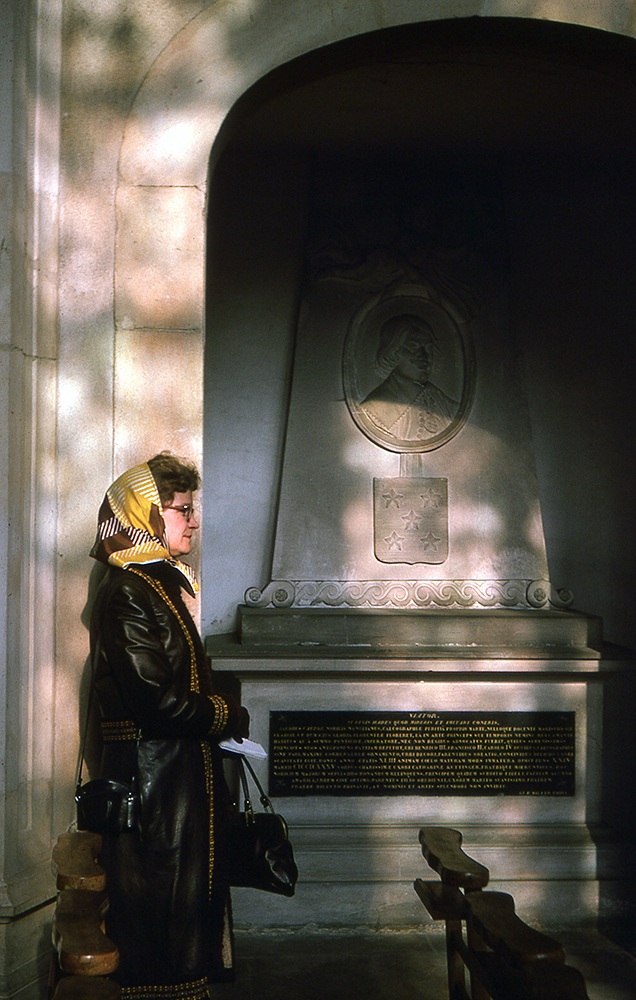
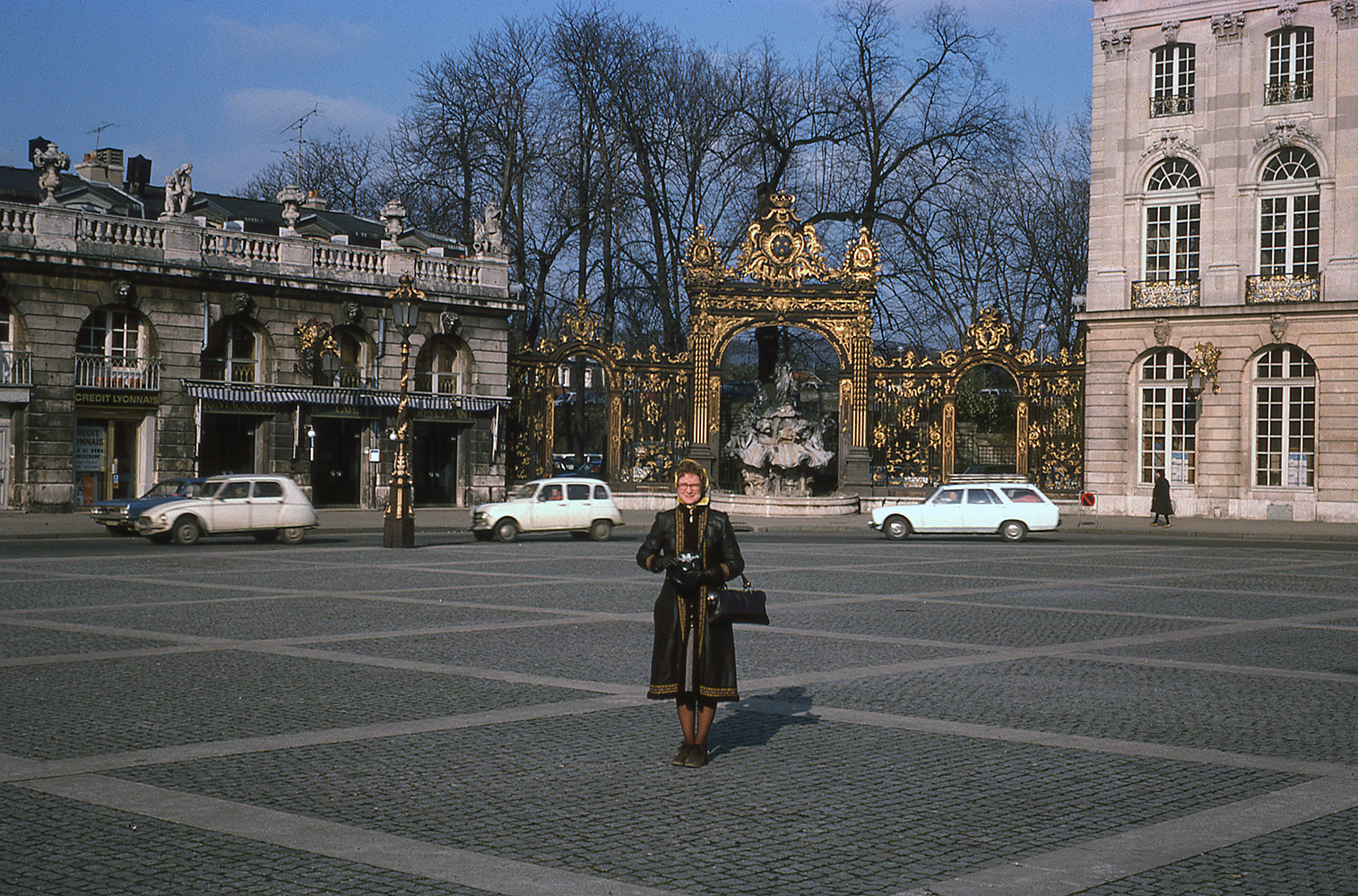
Once, I took a photo of Sue, radiantly happy, her curly red-blond hair shining in the sun, standing in Place Stanislas in Nancy. I keep this image of her enshrined in my mind’s eye, and in my heart.
- For this essay focusing primarily on Sue’s career at the MFA Boston, I have relied on my own perspective and recollections, both professional and personal, as well as her curriculum vitae, her oral history for the PCA, the published obituary in the Boothbay Register, the MFA Boston’s Annual Reports, notices and documents, interviews with her family, and current and former staff. I have benefited from the counsel of Clifford Ackley, former Chair of Prints and Drawings, who worked with Sue on many projects, advising her and learning from her. I am deeply grateful to many of Sue’s colleagues, family, and friends, for their insight, including Suzanne Boorsch, Alvin L. Clark Jr., Kate Harper, Anne Havinga, Shelley Langdale, Alison Luxner, Annette Manick, Katrina Newbury, Roy Perkinson, Thomas Rassieur, Beatrice (Bea) Reed, Elizabeth (Betsy) Reed, Marilyn Symmes, Carol Troyen, Benjamin Weiss, John Welsh, Amy Namowitz Worthen, and Joan Wright. I offer special appreciation to Kate Harper, Adam Tessier, and Debora Wood for their thoughtful editing of this article.
- “Obituary: Sue W. Reed,” Boothbay Register, December 2, 2025.
- Sue and John were parents to twins, Elizabeth (Betsy) and Beatrice (Bea), and grandparents to Nick and James. John died suddenly in 2023 while preparing to move to Maine to be closer to Sue, who resided in a care community in Boothbay Harbor.
- It is not clear whether Sue took Paul J. Sach’s famous museum course at the Fogg. Clifford Ackley observed that at that point, with her museum experience, she would not have needed it.
- Through the years, the department that held works on paper changed its name, adding Drawings, then Photographs, then dropping Photographs when its own department was formed. Presently, the department holding photographs has been reabsorbed into Prints and Drawings. Its name is Department of Prints, Drawings, and Photographs. In this article, I have often abbreviated the department name as simply Department of Prints or the department.
- Clifford Ackley joined the staff in 1966, and Barbara Stern Shapiro in 1974 (after volunteering for several years).
- David Acton, David Becker, Brent Benjamin, Victoria Binder, Helen Burnham, Barbara Butts, Elisa Germán, Mazie Harris, Genevra Higginson, Joanna Karlgaard, Penley Knipe, Shelley Langdale, Erin Sullivan Maynes, Elizabeth Mitchell, Rachel Mustalish, Kimberly Nichols, Tom Rassieur, Brooks Rich, Katherine Sanderson, Kate Steinway, and Joan Wright.